
File registration
Create a file reference, classification, subject and responsible office.
Know where a file is, who has it and what is needed next.
Proposed institutional solution with interface concepts.
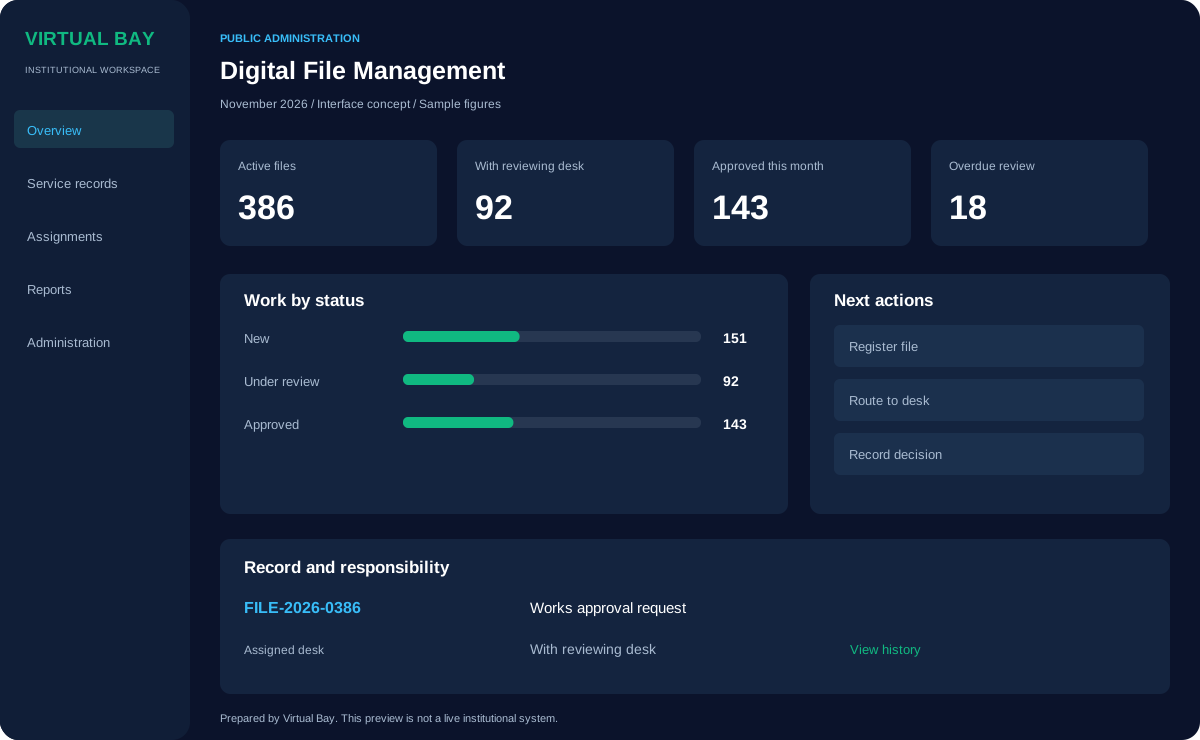
Interface concept with sample figures. Not evidence of a completed institutional deployment.
The problem
When a file moves between desks, staff can spend time asking where it has reached instead of completing the work. Missing context and unclear approval routes can create delays that are difficult to explain.
The proposed solution
Give each file a reference and a visible movement history. Connect the document, note, responsible desk and approval decision, with access and retention rules agreed before implementation.
Detailed modules
Each module has a purpose within the wider workflow, rather than becoming another disconnected screen.
Create a file reference, classification, subject and responsible office.
Organise attachments and versions so the current document is clear.
Route files through agreed desks and record decisions with supporting notes.
Find authorised records by reference or metadata and review their movement history.
Service workflow
This is a proposed system, supported by interface concepts. Modules, rules, integrations and delivery scope would be agreed during discovery.
Mobile application preview
The mobile view focuses on the task in front of the person: a reference number, the current status and the next action. Offline capture, device support and synchronisation would be scoped for the working environment.
Mobile interface conceptFile movement
Technology & integration
Integration depends on technical access, data quality, institutional approval and the provider’s terms. No existing government connection is implied.
Architecture can support role-based web applications, API services, structured databases and approved hosting. The final stack is selected after discovery.
Tell us where the process slows down, who uses it and what a better service should look like.